

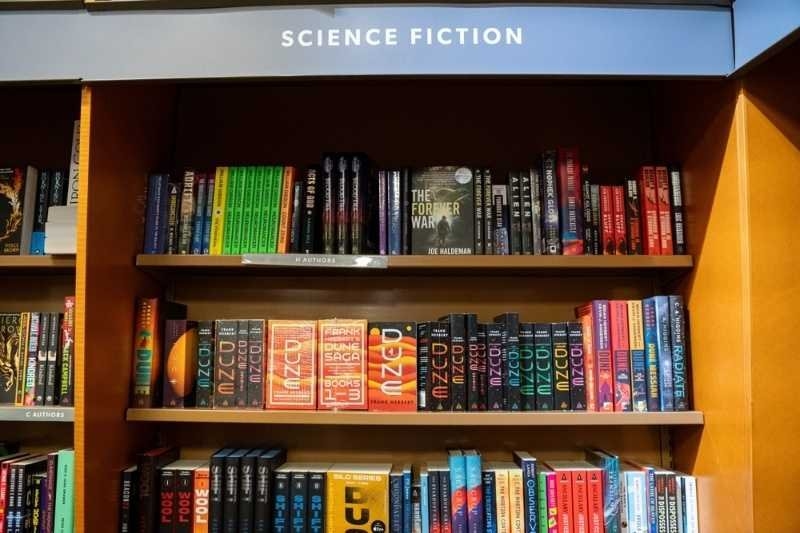
Getting lost in a completely different universe beats staring at a phone screen every single night. The genre pulls readers out of mundane daily routines and drops them into distant galaxies, dystopian futures, or alternate realities where the normal rules of physics no longer apply. Grabbing one of the best science fiction books completely rewires how a person looks at technology, space travel, and basic human survival.
Must Read: 5 Critical Thinking Books for Building a Sharp & Rapid Mind
Building a solid reading list starts with the absolute heavy hitters of the genre. These specific titles completely defined the landscape and continue to melt readers' brains decades after their initial release.
This desert planet saga essentially laid the groundwork for modern political space dramas. The heavy focus on resource control, giant sandworms, and religious fanaticism makes the political backstabbing feel completely relevant today.
Cyberpunk basically started right here on these pages. It predicted the internet, virtual reality, and corporate hacking long before anyone actually owned a personal computer or a smart device.
This story rips apart traditional gender roles by placing a human ambassador on an ice planet where the inhabitants shift their physical biology. It forces the audience to question basic human nature and cultural rules.
Tracking the collapse of a massive galactic empire requires a heavy dose of sociology and math. This classic maps out how societies fall apart and slowly rebuild from the ashes over hundreds of years.
A pizza guy with a samurai sword hacks his way through a digital universe. The plot just brutally roasts greedy corporations, screen addiction, and useless governments.
Seven travelers share their dark personal stories while heading toward a mysterious alien tomb guarded by a metallic killing machine. It reads exactly like a futuristic version of The Canterbury Tales but with terrifying time-traveling monsters.

Surviving a dead planet means taping broken gear together and growing potatoes in raw dirt. The author uses real chemistry instead of fake space magic, making the danger actually believable.
Top Pick: Open Book vs. Closed Book Exam: Which Is Better in 2026?
Science fiction books refuse to stay trapped in the past. While old fantasy stories usually stick to the exact same dragons and swords formula, futuristic writing constantly evolves alongside actual real-world technology. When scientists crack a new quantum computing milestone or launch a fresh telescope into orbit, authors immediately grab those real concepts and push them to extreme limits. Reading these stories acts as a weird preview of what humanity might actually face in a hundred years.
Authors use these fictional universes to strip away modern political noise and examine raw human behavior. Putting regular people in extreme, impossible situations—like a failing oxygen supply on a decaying space station—reveals exactly how society handles pure panic. These authors hide deep philosophical debates inside fast-paced action sequences involving massive laser fights and hostile alien invasions.
Tracking down a solid novel requires ignoring the generic bookstore endcaps completely. Finding the actual good stuff means digging into specific literary communities and paying attention to industry hardware.
These specific trophies represent the absolute peak of the genre. Browsing the list of past winners guarantees a high-quality read that the actual sci-fi community universally respects and debates.
Regular newspaper critics rarely understand hardcore sci-fi. Tracking down niche book blogs or YouTube reviews gets you real opinions from actual fans who grasp complex world-building.
Committing to a massive thousand-page epic feels daunting for newcomers. Grabbing a collection of short stories lets readers test out dozens of different authors and distinct writing styles over a single weekend.
One-off books easily kill time over a weekend, but massive series hook readers for months. Fans keep buying the next sequel because a single story just cannot hold that much detail.
Inventing a fake economy, alien language, and political structure takes a serious page count. A giant franchise lets the writer map out an entire galaxy instead of cramming everything into three hundred pages.
Watching a specific character age, make terrible mistakes, and eventually pass the torch to their kids hits hard. A long storyline allows for permanent consequences that actually matter to the reader.
Finishing a great book usually leaves a bitter feeling because the specific world ends. A massive ten-book franchise guarantees the reader has a reliable escape hatch from reality for several consecutive months.
Jumping into the genre starts by simply picking a flavor. Whether a reader wants a dark cyberpunk thriller, a mathematically accurate survival tale, or a massive political space opera, the options are practically endless. Grabbing any of the best science fiction books provides an immediate ticket out of regular life and drops the mind directly into the unknown.
Hard sci-fi strictly follows actual physics and real-world math to tell the story, making sure the futuristic tech could theoretically exist. Soft sci-fi ignores the strict math entirely, focusing much more on sociology, psychology, and the cultural impact of the fictional universe instead of explaining how the spaceship engines actually work.
Vintage books get computers hilariously wrong. Watching space captains use paper punch cards while jumping galaxies feels absurd today. But the underlying stories about corrupt governments and pure survival still hit hard. A great plot easily survives outdated fake gadgets.
Absolutely. Many popular space operas completely ignore the technical details of space travel. These stories function much more like traditional fantasy adventures or fast-paced political thrillers that just happen to take place on a spaceship instead of inside a medieval stone castle.
Normal sci-fi books hit about four hundred pages, taking most people a week or two to finish. But the giant genre classics easily double that length. Conquering an eight-hundred-page brick takes a full month if a reader only opens it for thirty minutes before falling asleep.
Speculative fiction acts as a giant umbrella term that covers everything weird or unnatural in publishing. It houses science fiction, high fantasy, alternate history, and supernatural horror all under one roof, basically serving as a catch-all category for any story that breaks the normal rules of reality.
This content was created by AI